Table of Contents
Introduction
Creating a devotional book, prayer journal, scripture cards, or other faith-based digital products can take considerable time.
The writing itself is only one part of the process. Creators may also need to organize ideas, prepare content, design pages, format a book, create printable materials, and prepare the final product for publishing.
Devotional Creator AI is designed to simplify some of these tasks by combining structured AI prompts with publishing templates and other resources.
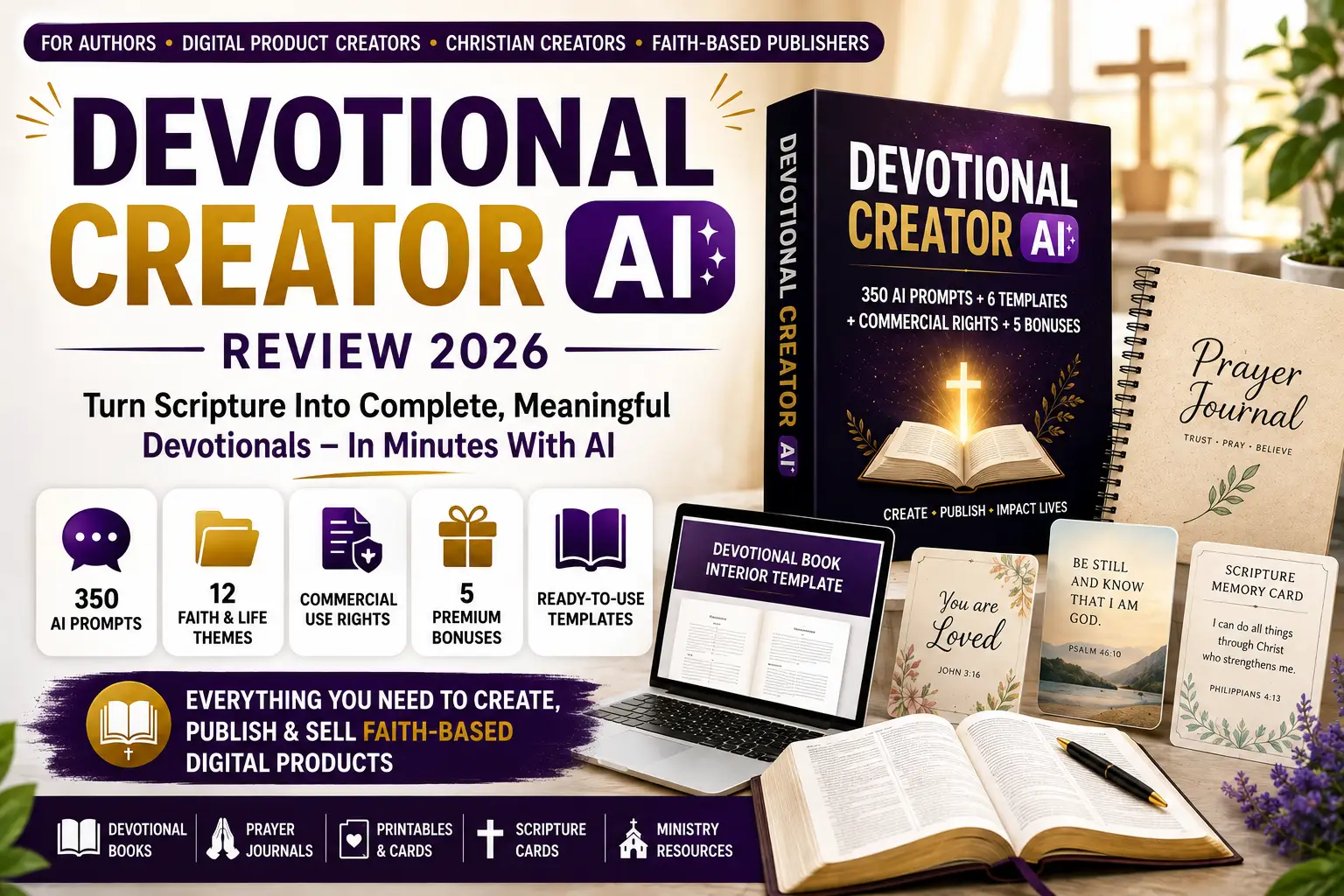
According to the official product page, the package includes 350 structured AI prompts, 12 faith and life themes, six ready-to-use publishing templates/resources, commercial rights, and five premium bonuses.
The product is aimed at authors, digital product creators, Christian creators, and faith-based publishers who want to create devotional and related content more efficiently.
Rather than simply providing a collection of generic AI prompts, Devotional Creator AI positions itself as a broader publishing toolkit. The vendor says users can generate content, place it into the relevant template, customize it, and prepare it for products such as devotional books, printables, prayer journals, and scripture memory cards.
In this Devotional Creator AI Review 2026, we’ll look at what the product includes, how it works, its main features, who may benefit from it, its advantages and limitations, pricing, and whether it could be useful for your content-creation workflow.
Product Details
| Product Name | Devotional Creator AI |
| Vendor | itechwarrior |
| Money-Back Guarantee | 14 Days |
| Official Website | www.devotionalcreatorai.com |
| Bonuses | Access Here |
| Pricing | $17 |
| OTO’s | Yes |

What Is Devotional Creator AI?
Devotional Creator AI is a faith-based AI content and publishing toolkit designed to help users create different types of devotional and Christian-oriented digital products.
At its core, the product provides a collection of structured prompts that can be used with AI to develop devotional content. The official page lists 350 devotional creation prompts covering 12 faith and life themes.
But the product goes beyond prompts.
It also includes resources such as a devotional book interior template, devotional cover template, printable devotional cards, prayer journal pages, scripture memory cards, and a getting-started guide.
🚀 Key Features of Devotional Creator AI
✍️ 350 Structured Devotional Prompts
The core of the package is a library of 350 structured prompts.
These prompts are designed around specific Scripture passages, real-life situations, tones, and output structures. For example, a prompt can define the Scripture, the situation a reader is facing, the desired tone, and sections such as a reflection, prayer, action step, and journal question.
This approach can give AI much more direction than a basic instruction such as “write a devotional about faith.”
🙏 12 Faith & Life Themes
The prompt library is organized around 12 faith and life themes, including the following:
- Anxiety & Peace
- Strength & Perseverance
- Hope in Hardship
- Faith & Trust
- Forgiveness & Grace
- Gratitude & Contentment
- Love & Relationships
- Purpose & Calling
- Wisdom & Guidance
- Healing & Restoration
- Joy & Celebration
- Prayer & Worship
These themes can provide starting points for different devotional books, journals, blog posts, or other faith-based content.
🎨 Devotional Cover Template
A devotional cover template is also included.
The idea is to give creators a starting design for presenting their finished devotional as a more complete product.
🎴 Printable Devotional Cards
Creators can use the included resources to develop printable devotional or encouragement cards.
These could potentially be adapted for personal use, gifts, churches, or digital-download products, subject to the applicable license.
🙏 Prayer Journal Pages
The toolkit includes prayer journal pages that can be combined with devotional content.
This makes it possible to create resources where readers don’t simply read a devotional but also have dedicated space for reflection and prayer.
💳 Scripture Memory Cards
Another included resource is a Scripture memory card format.
These can be designed as small, printable resources that readers can use for daily Scripture memorization.
💡 100 Faith-Based Digital Product Ideas
One of the bonuses provides 100 faith-based digital product ideas.
Examples mentioned on the sales page include prayer journals, Bible study workbooks, Scripture memory cards, women’s and men’s devotionals, children’s devotionals, Christian planners, gratitude journals, Bible reading trackers, and Christian coloring books.
⚙️ How Does Devotional Creator AI Work?
Devotional Creator AI follows a simple prompt → generate → review → customize → publish workflow. The important point is that the product does not provide finished devotionals to publish blindly. Instead, it provides structured starting points that you use with an AI assistant such as ChatGPT, Claude, or Gemini.
1. 🙏 Choose a Theme or Topic
Start by choosing a theme, Scripture, real-life situation, or target audience.
The prompt library covers 12 faith and life themes, including Anxiety & Peace, Hope in Hardship, Faith & Trust, Forgiveness & Grace, Purpose & Calling, Healing & Restoration, and Prayer & Worship.
2. ✍️ Select a Structured Prompt
Instead of writing a completely open-ended instruction, you select one of the 350 structured devotional prompts.
A prompt can provide details such as the following:
- Scripture reference
- Real-life situation
- Desired tone
- Reflection length
- Prayer
- Action step
- Journal question
This gives the AI clearer instructions about the type of devotional you want to create.
3. 🤖 Generate the First Draft
The selected prompt can then be pasted into your preferred AI assistant.
The official workflow specifically mentions ChatGPT, Claude, and Gemini as examples of AI tools that can be used to generate the first draft.
4. 🔍 Review & Personalize
This is one of the most important steps.
The generated content should be reviewed for Scripture accuracy, theology, tone, readability, grammar, and overall quality. You can then add your own ideas, experiences, writing style, and audience-specific details.
For faith-based content, this step is particularly important because AI-generated material can sometimes misunderstand context or make inaccurate statements.
5. 📘 Place the Content Into a Template
After editing, the finished content can be placed into the appropriate template.
The package includes templates for things such as devotional books, covers, printable devotional cards, prayer journals, and Scripture memory cards.
6. 📦 Package Your Content
Multiple related devotional entries can then be organized into a larger product.
For example, several entries around one theme could potentially become a 21-day devotional, 30-day devotional, prayer journal, workbook, or printable collection. These are possibilities for what the buyer can develop, not finished products included with the purchase.
7. 🚀 Publish or Share
Once the content has been reviewed, customized, and formatted, it can be prepared for the intended publishing channel.
The sales page mentions possibilities including Amazon KDP, Etsy, Gumroad, churches, ministries, email, social media, and personal websites.
⚙️ How Does Devotional Creator AI Work?
Devotional Creator AI follows a simple prompt → generate → review → customize → publish workflow. The important point is that the product does not provide finished devotionals to publish blindly. Instead, it provides structured starting points that you use with an AI assistant such as ChatGPT, Claude, or Gemini.
1. 🙏 Choose a Theme or Topic
Start by choosing a theme, Scripture, real-life situation, or target audience.
The prompt library covers 12 faith and life themes, including Anxiety & Peace, Hope in Hardship, Faith & Trust, Forgiveness & Grace, Purpose & Calling, Healing & Restoration, and Prayer & Worship.
2. ✍️ Select a Structured Prompt
Instead of writing a completely open-ended instruction, you select one of the 350 structured devotional prompts.
A prompt can provide details such as the following:
- Scripture reference
- Real-life situation
- Desired tone
- Reflection length
- Prayer
- Action step
- Journal question
This gives the AI clearer instructions about the type of devotional you want to create.
3. 🤖 Generate the First Draft
The selected prompt can then be pasted into your preferred AI assistant.
The official workflow specifically mentions ChatGPT, Claude, and Gemini as examples of AI tools that can be used to generate the first draft.
4. 🔍 Review & Personalize
This is one of the most important steps.
The generated content should be reviewed for Scripture accuracy, theology, tone, readability, grammar, and overall quality. You can then add your own ideas, experiences, writing style, and audience-specific details.
For faith-based content, this step is particularly important because AI-generated material can sometimes misunderstand context or make inaccurate statements.
5. 📘 Place the Content Into a Template
After editing, the finished content can be placed into the appropriate template.
The package includes templates for things such as devotional books, covers, printable devotional cards, prayer journals, and Scripture memory cards.
6. 📦 Package Your Content
Multiple related devotional entries can then be organized into a larger product.
For example, several entries around one theme could potentially become a 21-day devotional, 30-day devotional, prayer journal, workbook, or printable collection. These are possibilities for what the buyer can develop, not finished products included with the purchase.
7. 🚀 Publish or Share
Once the content has been reviewed, customized, and formatted, it can be prepared for the intended publishing channel.
The sales page mentions possibilities including Amazon KDP, Etsy, Gumroad, churches, ministries, email, social media, and personal websites.
✅ Devotional Creator AI Pros & Cons
👍 Pros
- 📖 Publishing templates: Everything from resources for devotional books, covers, prayer journals, cards, and scripture memory materials
- 💡 Product Ideas: 100 product ideas based on faith are included to help creators brainstorm new projects.
- 📅 Content planning: 365 Scripture-based content ideas to inspire your regular blog, social, email, or other content.
- ☑️ Quality Checklist: The AI Devotional Quality Checklist prompts users to check for accuracy in scripture, theology, tone, grammar, and readability before publishing.
- 💵 Low entry price: The front-end offer is advertised at $17 as a one-time purchase.
- 💼 Commercial use option: Vendor states that finished original creations using the prompts may be used commercially, subject to the applicable terms.
👎 Cons
- 🤖 AI still needs human review: Please do not publish the generated devotional content without checking and editing it.
- 🧠 Prompts are not ready-made products: The prompts are content starters, not ready-to-publish devotionals.
- 🎯 Niche Specific: If your products aren’t faith-based, you will probably get little value out of the toolkit.
- 📈 No guaranteed income: Prompts and templates don’t guarantee KDP, Etsy, or digital-product sales.
- 📜 Licensing needs attention: Commercial rights for finished creations do not mean the original prompt library can be resold or redistributed.
❓ Devotional Creator AI FAQs
1. How many AI prompts are included?
The package includes 350 structured devotional prompts covering different faith and life topics.
2. What themes are covered?
The prompts cover 12 themes, including faith and trust, anxiety and peace, hope in hardship, forgiveness and grace, gratitude, purpose, wisdom, healing, joy, and prayer and worship.
3. What types of products can I create?
The resources can be used as a starting point for products such as the following:
Devotional books
Prayer journals
Scripture memory cards
Devotional cards
Faith-based printables
Christian planners
Bible-related workbooks
Digital downloads
The exact commercial use should always follow the current license terms.
4. Can I sell products created with Devotional Creator AI?
According to the vendor, commercial rights are included for finished original creations made using the prompts. However, the original prompt library itself cannot simply be resold, redistributed, or given away.
5. Do I need professional design skills?
Not necessarily. The package includes several templates and publishing resources that can provide a starting structure for your products.
However, some basic editing and formatting knowledge can still be helpful when preparing a product for publication.
6. Is Devotional Creator AI worth it?
It can be worth considering if you regularly create faith-based content, devotional books, prayer journals, or Christian digital products.
Its value comes mainly from the combination of structured prompts, templates, product ideas, and content resources. It should not, however, be considered a guarantee of sales or passive income.
⭐ Devotional Creator AI Final Verdict
After looking at the features, workflow, included resources, pricing, and limitations, Devotional Creator AI appears to be a useful toolkit for people who want to create faith-based digital content with the help of AI.
Its biggest advantage is that it brings several resources together: 350 structured prompts, 12 faith and life themes, publishing templates, product ideas, content ideas, and a quality checklist. This can give creators a more organized starting point than using a general AI chatbot without any framework.
⭐ My Rating: 4.5/5
Best suited for:
- ✍️ Christian authors
- 📚 KDP publishers
- 🛍️ Etsy digital-product sellers
- ⛪ Churches and ministries
- 🙏 Devotional content creators
- 🧑💻 Faith-based entrepreneurs
- 📱 Christian bloggers and social-media creators